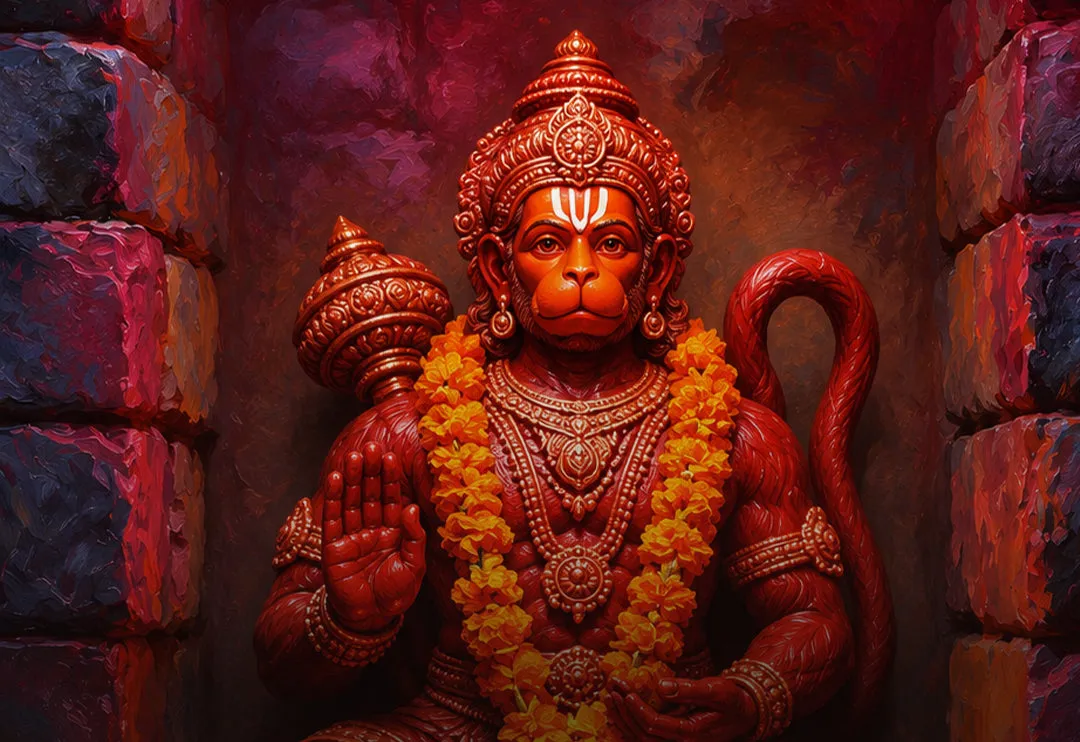
Through the day, remember Hanumān and His names whenever you can. Or keep a reminder for five minutes every hour, set aside purely for contemplation.
Reminders
Set your chanting time
Keep the same time on all 11 days. You get a reminder at that time, and one 2 hours earlier to finish your last meal, so the stomach is light when you chant.
Opened this from Instagram? Tap ··· and choose "Open in browser" first; in-app browsers often can't add calendar events.
Why this Stotra
If anyone asks what the most powerful invocation to Hanumān is, the answer is the Hanumān Vaḍvānal Stotra. The systematic way it invokes Hanumān shows in how many lives it has transformed.
The first example is Vibhīṣaṇa himself, who composed it. Rāvaṇa had all but declared him a traitor and wanted him prosecuted; his very life was at stake. He went on to become the king of Laṅkā. Imagine what it can do for us.
Follow the steps and perform the Sādhana to the best of your ability. If you do not have the ingredients, offer them mentally with devotion. Chanting with understanding matters more than collecting ingredients.
Eleven days
Tracker
Tap a day to mark it complete.
First step
Taking the Saṅkalpa and Dhyāna Kriyā
A Saṅkalpa is your conscious commitment to undertake a spiritual practice with sincerity and a clear intention. Take a few quiet moments to understand what you are committing to, then place that commitment at Hanumān's feet.
1
Cleanse yourself and prepare your space
Bathe or shower and wear fresh, clean clothes. If bathing is not possible because of travel, health or other circumstances, wash your hands, feet and face, and freshen yourself as best you can. Make sure your last meal was at least 2 to 3 hours before, to prevent belching and bloating during chanting.
Choose a suitable time. Set aside a time each day when you can chant calmly and without interruption. Early morning or evening is best, but choose what fits your routine. Keep the same time across the 11 days to build consistency. If your schedule keeps changing, complete your chanting at another suitable time that day.
Sit comfortably in your pūjā room or before an image of Hanumān. If travelling, choose a clean, quiet place where you can sit undisturbed for a few minutes.
2
Light a diya and settle your mind
Light a diya if your surroundings permit it safely. If you cannot, offer one mentally, but visualise it clearly.
Do not rush into the Stotra. Take a few slow, natural breaths and let yourself settle. Bring your attention to Hanumān. You need not force the mind to be completely silent; gently return to the prayer whenever it wanders.
Then perform the Dhyāna Kriyā: recite each of the 12 names slowly, pausing 5 to 10 seconds after each to reflect on its meaning and visualise Hanumān in that quality or scene.
3
Decide what you will practise
Be clear about your daily commitment: chanting the Vaḍvānal Stotra for 11 consecutive days. If you intend a particular number of recitations each day, decide it beforehand and include it in your statement.
Beginners: once a day.
Advanced practitioners: no more than twice a day. If chanting twice, it is better to do it in succession, one after the other.
4
State your Saṅkalpa
With folded hands, say it slowly. You may speak in English or in any language in which you can express your intention naturally.
After the Saṅkalpa, bow to Hanumān and begin the Vaḍvānal Stotra. Chant at a comfortable pace, paying attention to the words. At the end, offer your gratitude and sit quietly for a moment before returning to your day.
Continue to remember Hanumān and His names through the day whenever possible, or keep a five-minute reminder every hour for contemplation.
6
Other points: food
Take simple, easily digestible food, so body and mind can stay with the chanting and the names rather than with digesting a heavy meal.
Plant-based food is generally recommended whether or not you are doing a Sādhana. If you need to eat eggs, meat, or even onion and garlic, there is nothing to worry about. Dietary restrictions are mandated only in advanced stages; as a beginner you need not enforce them. As you continue, an awareness grows and your diet changes by itself, without guilt or fear.
Second step
Concluding the Sādhana
Whatever you begin, you formally close. The conclusion is called Udyāpana Vidhi (उद्यापन विधि).
Recite each name slowly. Pause 5 to 10 seconds to reflect on its meaning and see Hanumān embodying that quality or appearing in the scene. Give each name your attention and devotion; do not rush.
Step 4
Your Saṅkalpa
Fill in your name and daily count. With folded hands, say it slowly in English or any language that lets you express your intention naturally.
श्रीविभीषणकृतं · composed by Vibhīṣaṇa
Hanumad Vaḍvānal Stotra
Rishi: Śrī Rāmacandra. Devatā: the Vaḍvānal form of Hanumān. Read it verse by verse with the word meanings, or switch to the full text when you chant.
When you chant a Stotra, visualising it matters most. Visualisation cleanses and purifies, and it brings you closer to your Devatā. Chanting with no feeling attached is of no use. Words have meaning; the meaning has to be felt and then expressed.
1
Read the whole Stotra first
Go through the entire text and meanings once.
2
Study a few words each day
Verse by verse, study each word and visualise it. Spread this over 7 to 10 days; it need not be done in one sitting.
3
Hold the image
Hold each visualisation as long as you can. Absorb the feeling and energy. Do this for every word. Take your time.
रणपर्वतोत्पाटनraṇaparvatotpāṭana raṇa in the battlefield · parvata mountains · utpāṭana uprooting from the roots. Imagine Hanumān uprooting mountains and holding them high on the battlefield.
4
Chant with the images alive
Once mastered, chant the Vaḍvānal again and feel the surge of emotion. You no longer hold each image for long; hold it only as long as your chanting speed allows.
Second step · उद्यापन विधि
Udyāpana: closing with sevā
If you have started something, you close it formally. That is a moral and an ethical responsibility. Udyāpana concludes the Sādhanā with gratitude and lets its spirit find expression in an offering.
On the 11th dayFri, 20 NovDevotthāna Ekādaśī
Or any day untilSun, 20 Decwithin 30 days of your last chanting
StatusNot yet
The offering
There are several ways to observe Udyāpana. For this Hanumān Sādhanā, a simple act of sevā is especially encouraged.
1
Pūjā at a Hanumān temple
Visit a nearby Hanumān temple and offer a pūjā.
2
Distribute prasād
With the temple's permission, spend an hour or two distributing prasād to those who visit. Serve each person with warmth and attention. You may know nothing of their worries or the prayer they brought that day, yet for a moment you can offer them something with kindness.
3
A bhandāra, if your means permit
Organise a meal offered to devotees and others at the temple. Give its preparation and serving the same care you gave your chanting: coordinate with the temple, keep food and surroundings clean, and welcome people with dignity.
4
Linger
If possible, instead of leaving straight after the pūjā, sit quietly before Hanumān. Listen to the prayers, watch devotees arrive, and be present without another task waiting. Reflect on your practice and give thanks.
Let the offering be within your means and wholehearted. There is no need to spend beyond your capacity.
Doing it as a group
Join hands with fellow devotees, each contributing what they comfortably can. Each contribution has its place.
Contributemoney towards the offering
Cookprepare the meal
Serveoffer it to those who come
Cleanstay behind and tidy up
Why sevā
We do not live or grow in isolation. We belong to families, communities and a culture sustained by countless acts of care. Closing the Sādhanā by serving others acknowledges this; the devotion nurtured in private becomes something another person can receive.
At the end it is easy to start counting: "I completed these many days. I performed this much japa." Sevā redirects that thought:
By His grace, I was able to begin. By His grace, I was able to complete it. May I now offer something in gratitude.
Hanumān's devotion finds its fullest expression in service. Let the hands you folded in prayer become the hands with which you serve.
Mānava Sevā is a way to realise that I alone cannot do anything in this world. For me to exist there has to be a farmer, a vegetable seller, a spice merchant, and somebody to take the trash. Sevā is what Hanumān did all through the Rāmāyaṇa, and it is what we ought to do after this Sādhanā.
Carry this prayer into your Udyāpana
Hanumān, may whatever goodness this Sādhanā has nurtured in me reach the lives of others. May I remember Your grace in the way I live and serve.